Table of Contents
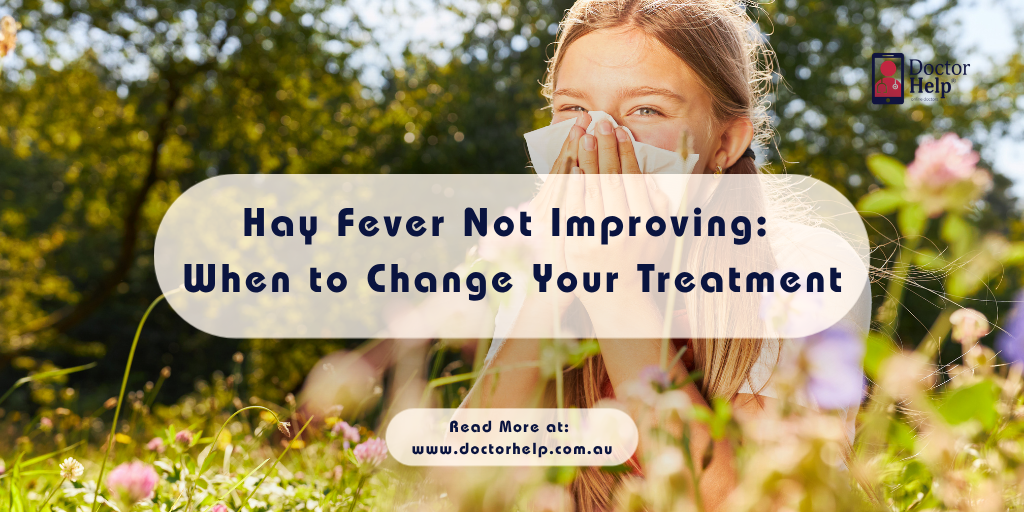
Spring rolls around, the jacarandas start doing their thing, and so does your nose. You grab the same antihistamine that’s always done the trick, pop one every morning like clockwork, and wait for relief that just doesn’t quite arrive this year. If your usual hay fever treatment not working has left you sneezing through meetings and rubbing your eyes raw by lunchtime, you’re not imagining it, and you’re definitely not alone.
In this article, we’ll look at why the tablet that worked fine last year might be falling short now, when a nasal spray does a job antihistamines simply can’t, how to tell if something other than hay fever might be behind your symptoms, and when it’s worth getting proper testing or a second opinion rather than just buying a bigger box of tablets.
What Is Hay Fever
Hay fever, known more formally as allergic rhinitis, one of the most common allergic conditions across Australia and New Zealand, estimated to affect somewhere around one in four Aussies, with rates varying by age, state and how it’s measured.
Despite the name, there’s no hay involved, and no actual fever either. It happens when your immune system overreacts to something perfectly harmless floating around in the air, usually grass or tree pollen, dust mites, mould spores, or pet dander, and responds as though it’s under attack.
Hay fever symptoms typically include a blocked or runny nose, repeated sneezing, itchy and watery eyes, and sometimes an itchy throat or ears that just won’t quit.
Read: Christmas Tree Syndrome: Hidden Allergy Triggers from Real & Artificial Trees
Why Antihistamine Tablets Sometimes Are Not Enough
Here’s the bit that trips a lot of people up. Antihistamines are genuinely good at their job, but their job is narrower than most people assume. They’re built to handle the sneezing, itching, and watery eyes side of things. For nasal congestion, post-nasal drip, or a blunted sense of smell, antihistamines alone often aren’t enough, and that’s when adding a nasal spray becomes the next logical step rather than a sign your antihistamine has failed you personally.
There’s also a dosing reality worth knowing. Antihistamines mostly provide relief for mild, occasional symptoms, the kind that show up now and then rather than every single day. If you’re needing hay fever medicine daily just to function, and you’re still stuffed up despite taking it religiously, that’s less “this medicine doesn’t work” and more “this symptom needs a different tool.”
When Nasal Sprays Work Better Than Tablets
This is where intranasal corticosteroid sprays, usually just called INCS, earn their keep. They’re recommended as first-line therapy for allergic rhinitis in Australian guidance, and for good reason. They work directly where the inflammation is happening, right in the nose, rather than travelling through your whole system to calm things down indirectly.
The catch, and it’s a genuinely common reason treatment “stops working,” is timing and consistency. They usually need several days to a couple of weeks of consistent daily use before you notice their full effect, and using them only occasionally tends to make them far less effective. If you’ve been using nasal spray only on the bad days, that’s likely the missing piece, not a faulty product. When it comes to seasonal symptoms, starting your daily spray in the weeks prior up to the start of pollen season, which in Australia typically lasts from spring to early summer and continuing all the way through, tends to work far better than starting once symptoms have already set in.
Saline rinses are worth a mention too, not as a replacement but as backup. They help wash pollen out of the nose and can genuinely improve how well your other sprays work when used beforehand. As for decongestant sprays and tablets, they can offer short-term relief, but they’re best used with caution and only for a few days at a time, since overuse can actually make congestion worse in the long run, and anyone with high blood pressure should check with a pharmacist or doctor first.
Signs It May Not Be Hay Fever At All
Sometimes what looks like stubborn hay fever is something else wearing a very similar disguise. Symptoms can suggest allergic rhinitis, but other causes are certainly possible, and it’s worth keeping an eye out for a few tell-tale differences.
A cold or flu tends to come with body aches, a sore throat, and symptoms that clear up within a week or two, whereas hay fever can drag on for the entire pollen season. Facial pain, pressure around the cheeks or forehead, or thick discoloured discharge can point toward sinusitis instead, which can sometimes occur alongside allergic rhinitis. If your “hay fever” has started coming with a fever, facial pain, or symptoms that just won’t budge no matter what you throw at them, it’s reasonable to wonder whether the label has changed.
Also read: Sinus Headache Or Migraine? Why The Pain Behind Your Eyes Keeps Coming Back
When Allergy Testing or Asthma Review Helps
Not every case of hay fever needs testing, and plenty of people manage perfectly well with pharmacy treatments and a sensible routine. But when symptoms are severe, persistent, or simply not responding despite doing everything right, a doctor may arrange further assessment if clinically appropriate. This might include allergen-specific IgE blood testing, or a referral for specialist skin-prick testing to pin down exactly what you’re reacting to. Knowing the specific trigger can make avoidance strategies far more targeted than just guessing.
It’s also worth knowing that managing allergic rhinitis well is closely tied to managing asthma when the two overlap, so if a cough, wheeze, or breathlessness has crept in alongside your usual sneezing, a spirometry or asthma review referral is a reasonable next step rather than something to brush off as “just the pollen being bad this year.”
For those with genuinely severe or poorly controlled symptoms, allergen immunotherapy, sometimes called desensitisation, is a treatment your doctor might discuss, involving small, gradually increasing doses of the allergen itself, either by injection or under the tongue, to help your immune system stop overreacting over time. It’s not a quick fix, and it’s not for everyone, but it’s worth knowing it exists.
When Telehealth Can Step Up Treatment
Telehealth may be suitable for a lot of hay fever cases, particularly when it’s simply a matter of reviewing what you’ve tried, checking your technique with a nasal spray, or stepping up from tablets to a combination treatment. A doctor can talk through your symptom pattern over video and adjust your plan without you needing to sit in a waiting room sniffling into a tissue.
If you experience wheeze, shortness of breath, or sudden difficulty breathing alongside your usual symptoms, this needs urgent, in-person medical attention, and shouldn’t wait for a scheduled appointment. Book a proper in-person review if you experience fever, facial pain, or eye pain alongside your hay fever symptoms, since these symptoms can sometimes point toward something needing a closer look than a camera allows.
And if you know pollen sets you off, it’s genuinely worth knowing that staying indoors during, before, and after thunderstorms in pollen season isn’t overcautious advice, thunderstorm asthma is a real and occasionally serious phenomenon in parts of Australia.
Hay fever has a habit of changing its behaviour from one season to the next, and what worked brilliantly last spring doesn’t always hold up this time around. If you’ve been cycling through box after box of antihistamines and still can’t breathe easy, this might be your sign. Book your telehealth consultation today and let’s get to the bottom of it.
References:
- Healthdirect Australia. (2025, January 23). Hay fever (allergic rhinitis). Symptoms, Treatments and Causes | Healthdirect.
https://www.healthdirect.gov.au/hay-fever - National survey reveals widespread burden of allergic diseases across Australia – National Allergy Centre of Excellence. (n.d.).
https://www.nace.org.au/knowledge-hub/news-media/2026/national-survey-reveals-widespread-burden-of-allergic-diseases-across-australia/ - Katelaris, C. (n.d.). Can I take antihistamines everyday? More than the recommended dose? Here’s what the research says – National Allergy Centre of Excellence.
https://www.nace.org.au/knowledge-hub/news-media/2024/can-i-take-antihistamines-everyday-more-than-the-recommended-dose-here-s-what-the-research-says/ - Grainger, S. (n.d.-a). Allergic rhinitis Clinical update. Australasian Society of Clinical Immunology and Allergy (ASCIA).
https://www.allergy.org.au/hp/papers/allergic-rhinitis-clinical-update - Administrator, Administrator, Administrator, Administrator, & Administrator. (n.d.). Conditions Allergy – Australasian Society of Clinical Immunology and Allergy (ASCIA).
https://allergy.org.au/?id=67&view=category - Grainger, S. (n.d.-c). Allergy testing. Australasian Society of Clinical Immunology and Allergy (ASCIA).
https://www.allergy.org.au/patients/allergy-testing/allergy-testing - The National Asthma Council Australia. (n.d.).
https://www.nationalasthma.org.au/living-with-asthma/resources/patients-carers/brochures/hay-fever-allergic-rhinitis-and-your-asthma
Reviewed By: Dr. Momal Ahmad.