Table of Contents
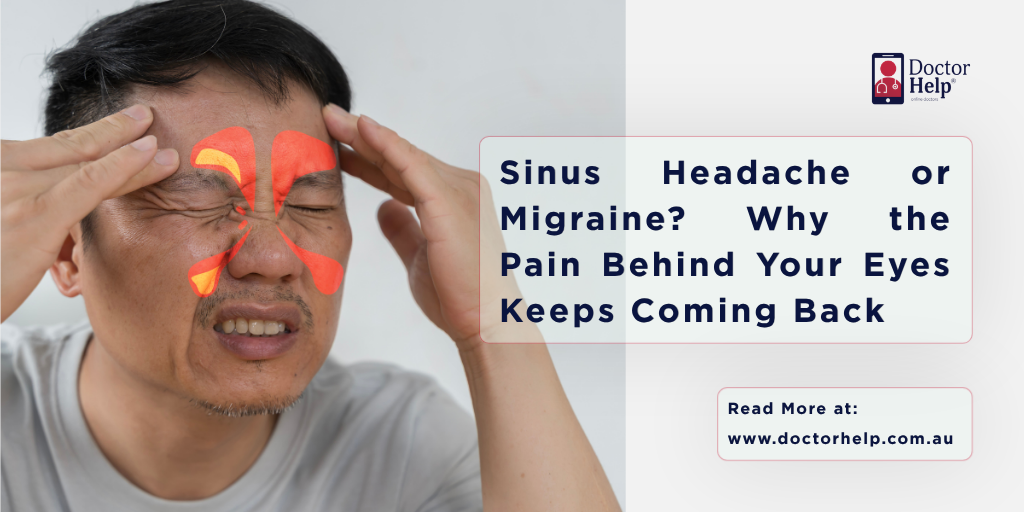
It starts behind the eyes.
A heavy pressure across the forehead.
A blocked nose.
Maybe pain in the cheeks, temples or upper teeth. You bend forward and the pressure feels worse. Your face feels full, your head feels thick, and the first thought is obvious.
Sinus.
So you treat it like sinus.
Nasal spray.
Steam.
Decongestants.
Painkillers.
Maybe antibiotics once or twice.
Sometimes it settles. Sometimes it comes back. Sometimes it never fully leaves. And every few weeks or months, the same pressure returns behind your eyes like your head is filling up from the inside.
But here is the part many people do not realise.
A lot of “sinus headaches” are not sinus headaches at all.
They are migraine.
Not always the dramatic kind where someone lies in a dark room vomiting. Not always with flashing lights. Not always one-sided. Migraine can sit behind the eyes, cause facial pressure, make the nose feel blocked, and mimic sinus pain so convincingly that people spend years treating the wrong problem.
That is the sinus headache trap.
Why sinus feels like the obvious answer
Sinus headache sounds logical because the pain is in the right place.
Forehead.
Cheeks.
Behind the eyes.
Bridge of the nose.
Upper teeth.
If the nose is blocked too, the case feels closed. Surely it must be sinus pressure.
Sometimes it is.
Acute sinusitis can follow a cold or respiratory infection. The sinuses become inflamed, mucus thickens, and facial pressure can develop. A true sinus infection may come with thick yellow or green discharge, fever, reduced smell, cough, bad breath, and symptoms that last more than a few days or worsen after initially improving.
But sinusitis is not the only reason you can feel pressure in your face.
Migraine can activate nerves that also supply the sinuses, eyes, teeth, jaw and face. That is why migraine pain does not always stay in the classic “one side of the head” pattern.
It can feel facial.
It can feel nasal.
It can feel like sinus.
The migraine symptoms people miss
Many people do not call their headaches migraine because they have a narrow idea of what migraine looks like.
They think migraine must mean:
flashing lights
vomiting
unbearable pain
lying in a dark room all day
missing work every time
But migraine can be more varied than that.
It may include:
- throbbing or pulsing pain
- pressure behind the eyes
- pain that worsens with movement
- sensitivity to light
- sensitivity to sound
- nausea or loss of appetite
- neck stiffness
- brain fog
- fatigue before or after the headache
- dizziness
- watery eyes
- nasal congestion
- symptoms triggered by sleep changes, stress, alcohol, weather or hormones
That last part surprises people.
A blocked nose or watery eye does not automatically mean sinus. Migraine can cause nasal symptoms too.
This is why people get stuck. They treat the nose, but the real driver is neurological.
The clue is what happens around the headache
Instead of asking only, “Where is the pain?” ask what comes with it.
Does light bother you?
Does noise feel sharper?
Do you feel nauseous?
Do you want to lie still?
Does movement make it worse?
Do you get brain fog before or after?
Does it happen around your period?
Does it follow poor sleep, stress, skipped meals, alcohol or weather changes?
Does the headache keep returning even when your sinus symptoms are mild?
Those questions point more toward migraine than sinus.
A true sinus headache usually sits inside a bigger sinus infection picture. There is often nasal discharge, infection symptoms, reduced smell, fever or symptoms after a cold.
Migraine may arrive with a blocked nose, but the headache itself often feels more disabling than the congestion.
You are not just stuffy.
You are wiped out.
Why antibiotics may not help
This is where the cycle becomes frustrating.
A person gets repeated “sinus headaches” and is given antibiotics, or expects antibiotics, because they assume infection is the cause.
But antibiotics only help bacterial infections.
They do not treat migraine.
They do not treat viral sinus inflammation.
They do not treat allergy.
They do not treat tension headache.
If the pain keeps returning and antibiotics have not clearly fixed the pattern, it may be time to question the diagnosis rather than keep repeating the same treatment.
This does not mean sinus infections are never bacterial.
They can be.
But recurring facial pressure and headache should not automatically be treated as infection every time, especially when migraine features are present.
What a real sinus pattern tends to look like
Sinusitis often follows a cold.
You may have nasal congestion, thick discharge, facial pressure, reduced smell, cough, tiredness, fever or worsening symptoms after initially seeming to improve.
The pressure may worsen when bending forward. The face may feel tender. The upper teeth may ache.
A short-lived viral sinus infection often improves with time and supportive care. Bacterial sinusitis is less common and may be considered when symptoms are severe, prolonged, or worsening after initial improvement.
The key is that sinusitis usually behaves like an infection or inflammation in the nose and sinuses.
Migraine behaves like a headache disorder that may borrow sinus-like symptoms.
That difference matters because the treatment plan is different.
What a migraine pattern tends to look like
Migraine often has a pattern, even if the person has never noticed it.
Maybe it comes after a bad sleep.
Maybe the day before your period.
Maybe after red wine.
Maybe when you skip lunch.
Maybe during weather changes.
Maybe after a stressful week, not during it.
Maybe after staring at screens for hours.
Maybe it begins with yawning, mood change, neck tightness, food cravings or brain fog before the pain arrives.
Then the headache hits.
Behind the eye.
Across the forehead.
One side.
Both sides.
Face pressure.
Nausea.
Light sensitivity.
A need to lie down.
Then, after the pain fades, you feel hungover. Drained. Foggy. Not quite back online.
That is not “just sinus”.
That pattern deserves a migraine conversation.
The danger of self-diagnosing every headache
Most headaches are not dangerous.
But some need urgent attention.
You should seek urgent medical care if you have:
- a sudden severe “thunderclap” headache
- headache with fever, neck stiffness or confusion
- headache with weakness, numbness, facial drooping or trouble speaking
- new vision loss or double vision
- headache after a head injury
- headache that is progressively worsening
- new headache during pregnancy
- headache with seizure
- headache that wakes you repeatedly or is worse lying down
- a new severe headache if you are over 50
- headache with a rash, severe eye pain or a very red eye
Do not label a new severe headache as sinus or migraine without assessment.
The first rule is safety.
The second rule is accuracy.
What treatment looks like when it is migraine
Migraine treatment is not just “strong painkillers”.
A doctor may look at how often attacks happen, how disabling they are, what symptoms come with them, what you have already tried, and whether there are red flags.
Some people manage occasional migraine with early use of simple pain relief, rest, hydration and a dark quiet room.
Others may need migraine-specific medication, anti-nausea treatment, a prevention plan, or medication to reduce attack frequency.
Timing matters too.
Migraine medicine often works better when taken early, before the attack fully escalates.
That is one reason diagnosis matters.
If you keep waiting until the “sinus pressure” becomes unbearable, you may be missing the best treatment window.
When telehealth can help
If your headache is severe, new, unusual, or comes with red flags, you need urgent in-person care.
But if you have recurring headache episodes that sound like migraine, no emergency symptoms, and you need help understanding the pattern, telehealth can be a practical first step.
Through Doctor Help, you can book a private consultation with an Australian-registered doctor. Where clinically appropriate, the doctor may help assess whether your symptoms sound more like migraine, sinusitis, allergy, tension headache or something that needs in-person review.
They may also discuss treatment options, medication safety, trigger patterns, and whether you need further assessment.
The point is not to diagnose every headache online.
The point is to stop treating the same recurring pain as “sinus” if the pattern does not fit.
The question is not sinus or nothing
People often think there are only two possibilities.
Either it is sinus, or they are overreacting.
That is not true.
Facial pressure and pain behind the eyes can come from sinusitis, migraine, allergy, tension headache, eye strain, dental problems, jaw issues, medication overuse, or other medical causes.
The mistake is not assuming sinus once.
The mistake is assuming sinus forever.
Especially when the treatments do not work.
Especially when the headaches keep returning.
Especially when nausea, light sensitivity, movement sensitivity or post-headache exhaustion are part of the story.
Your body may be giving you a pattern.
You just need someone to interpret it properly.
When the “sinus headache” keeps coming back
If you have been treating facial pressure as sinus for months or years, pause before buying another nasal spray.
Ask a better question.
Is there thick nasal discharge and fever?
Did it start after a cold?
Does it resolve when the sinus symptoms resolve?
Or does the headache come with nausea, light sensitivity, brain fog, fatigue, movement sensitivity or predictable triggers?
Because the answer changes the treatment.
A recurring headache behind the eyes is not something you have to keep guessing about.
It may be sinus.
It may be migraine.
It may be something else.
But if the same pain keeps coming back, the next step is not another round of random treatment.
It is a clearer diagnosis.
Disclaimer:
This article provides general information only and does not replace personal medical advice. Headache, facial pain, sinus symptoms, migraine symptoms, vision changes, fever, neurological symptoms or severe pain should be assessed by a qualified healthcare professional. Seek urgent care for sudden severe headache, headache with weakness or confusion, fever with neck stiffness, new vision changes, headache after injury, or symptoms that are rapidly worsening.
References:
- Healthdirect Australia — Migraine
- Healthdirect Australia — Sinusitis
- Healthdirect Australia — Headaches
- American Migraine Foundation — How to Know if You Have Migraine or Sinus Headache
- Migraine & Headache Australia — Headache and migraine information
Reviewed By: Dr. Momal Ahmad.