Table of Contents
There’s a particular kind of misery that comes with an itch you can’t outrun. You shower, you moisturise, you tell yourself it’s just dry skin and then 2am rolls around and you’re wide awake, scratching at your wrists like there’s something living under there. Spoiler: there might be. Scabies has a way of turning ordinary nights into a battle, and if you’re reading this at your wit’s end, you’re not alone, and you’re not overreacting.
This guide covers scabies treatment in Australia the way our own health authorities and clinicians actually recommend it.
What’s Actually Going On Under Your Skin
Scabies is caused by a microscopic mite, Sarcoptes scabiei, that burrows into the top layer of skin to lay its eggs. It’s not a hygiene issue, and it’s not a reflection of how clean your house is. It affects people regardless of how often they wash and it isn’t something pets pass on to humans. It spreads through prolonged skin-to-skin contact, which is why entire households, share houses, and couples so often end up dealing with it together rather than one unlucky person at a time.
Scabies Symptoms
Most people don’t clock what’s happening straight away, because the early symptoms can look like a dozen other things such as heat rash, an allergic reaction, or even stress hives. But there’s a pattern worth knowing:
- Intense itching, often disproportionate to how the skin actually looks
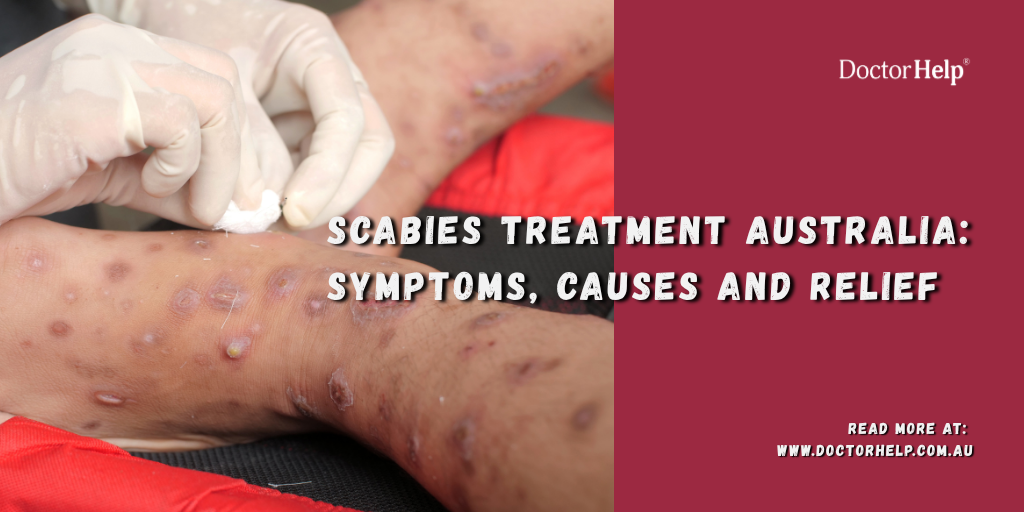
- Small red bumps, blisters, or thin greyish lines (burrows) on the skin
- A rash that favours the webbing between fingers, wrists, elbows, underarms, and waistline
- Symptoms that appear on multiple household members around the same time
One of the most reliable scabies symptoms and the one that sends people searching at midnight is usually the itching worse at night pattern. The mites are most active in warmth, and your skin temperature rises slightly once you’re tucked in bed, which is exactly why the itch seems to save its worst for when you’re trying to sleep. It isn’t your imagination, and it isn’t “just anxiety.” It’s biology working against your bedtime.
Scabies Treatment
In Australia, permethrin 5% cream is a commonly used first‑line topical treatment for scabies in many patients, but children, pregnant people, and crusted or complicated cases may need alternative medication under specialist or GP guidance.
Permethrin scabies treatment is what most Australian GPs and pharmacists will walk you through, and the routine typically looks like this:
- Apply the scabies cream after a shower or bath, once your skin is completely dry
- Cover your entire body from the neck down (or from the chin down, including the scalp and face, for infants, young children, and those in central and northern Australia, where scabies above the neck is more common)
- Leave the cream on for the recommended period before washing off generally overnight
- Repeat the application seven days later to catch any mites that hatch from surviving eggs
- Treat every member of the household and any close contacts at the same time, even if they’re not yet itchy
That last point trips people up constantly. It feels excessive to treat someone with zero symptoms, but scabies has an incubation period, and skipping a housemate is often exactly how the whole cycle starts again a few weeks later.
For cases where permethrin isn’t suitable or hasn’t worked, benzyl benzoate 25% serves as the second-line topical option in Australian clinical practice, while oral ivermectin may be considered for more extensive or crusted presentations, particularly in settings where topical application is impractical. None of these are decisions to make solo from a symptom checklist, they need a clinician’s eye.
Read: 10 Common Skin Conditions and Ways to Heal Them
Why Are Spots Still Appearing After Scabies Treatment?
This is, hand on heart, one of the most common and most anxiety‑inducing questions people ask after doing everything right. There are two main scenarios.
1. You’ve applied the scabies cream, you’ve washed the sheets, you’ve followed the seven‑day rule and yet the fact that spots are still appearing after scabies treatment can feel like proof the medication has failed you.
Take a breath. It usually hasn’t. The medication kills the mites, but it doesn’t instantly erase the skin’s reaction to them. In fact, some people develop an immune response to the mites, their eggs, or their waste that can keep the itch going for roughly 2 to 4 weeks after the mites themselves are dead. Think of it as an echo rather than an ongoing infestation. However, if you’re seeing new burrows, new rashes appearing rather than fading, and things haven’t improved after about 4 weeks, then that’s a sign to book a review with your clinician.
2. Or the scabies may be coming back because of missed contacts, incorrect application, or not repeating treatment at the 7‑day mark, rather than the medication simply “not working”.
Getting Scabies Treatment Online in Australia
Not everyone can duck into a GP clinic during business hours, especially with a condition that thrives on discretion and comfort. This is where scabies treatment online in Australia has made access noticeably easier. A telehealth consultation lets a registered doctor assess your description and photos of the rash, ask about your household situation, and send a prescription straight to your phone for pickup at a local pharmacy, if appropriate. It won’t replace an in-person skin scraping for tricky or atypical cases, but for typical presentations, it can be a suitable pathway for classic cases, and may help you avoid the waiting-room shuffle.
Also read: Understanding Skin Conditions And How To Treat Them
Breaking the Cycle: Beyond the Cream
Treating your skin is only half the job. Mites can survive away from a human host for a day or two, so:
- Wash bedding, towels, and recently worn clothing in hot water and dry on a hot cycle
- Seal anything unwashable (soft toys, delicate fabrics) in a plastic bag for about a week
- Vacuum mattresses and soft furnishings rather than reaching for insecticide sprays, which aren’t recommended for scabies control
Conclusion
Skin conditions have an infuriating habit of mimicking one another and early scabies can look almost identical to an allergic reaction to an untrained eye, especially at 2am with a phone torch. But keep in mind: reading about what a rash is and actually having a doctor examine your skin are two very different experiences. If the itch has lasted for longer than a couple days, is spreading, and making it hard to get a good night’s sleep, it’s worth getting it looked at properly by a doctor rather than trying to match it to photos online.
If you’re ready for a clearer answer instead of another sleepless scroll, you can book a consultation through Doctor Help so a doctor can review your symptoms, confirm whether it’s scabies, and suggest a treatment plan that fits your situation.
Disclaimer: This article is general information only and does not replace medical advice. If your rash is spreading rapidly, you feel unwell, or have crusted or thickened skin, seek prompt medical care.
References:
- Department of Health & Human Services. (n.d.). Scabies. Better Health Channel.
https://www.betterhealth.vic.gov.au/health/conditionsandtreatments/scabies - Healthdirect Australia. (n.d.). Scabies. Treatments, Symptoms and Causes | Healthdirect.
https://www.healthdirect.gov.au/scabies - Department of Health. Victoria, Australia. (2024, July 10). Scabies control guidelines. health.vic.gov.au.
https://www.health.vic.gov.au/infectious-diseases/scabies-control-guidelines - The Royal Australian College of General Practitioners. (n.d.). Scabies: A clinical update. Australian Family Physician.
https://www.racgp.org.au/afp/2017/may/scabies-a-clinical-update
Reviewed By: Dr. Momal Ahmad.