Table of Contents
Gym mirrors can tell you a lot, but they won’t tell you what’s really happening inside your body, and that silence is exactly what leads plenty of training-minded, health-conscious folks to follow a familiar breadcrumb trail and search for a comprehensive health check blood test, after a bad week of recovery or an episode of a podcast about the best way to run your hormones.
Maybe energy has been a little lacking despite training well. Maybe sleep has been a little poor and you just can’t quite put your finger on why. That makes sense. What trips people up is thinking blood testing in Australia works like an online shopping cart, where you just select all of the panels that sound interesting. There’s a process to it, and it usually begins with a chat, not a form.
Why can’t I simply choose every blood test I want?
It is natural to be curious about what is happening inside your body. However, pathology testing is not quite like ordering individual items from an online shop.
A doctor considers your symptoms, age, medical history, family history and other relevant factors before deciding which investigations may be appropriate. Some tests can help identify a health problem, while others may add little useful information when there is no clear reason to order them.
The Royal Australian College of General Practitioners (RACGP) provides evidence-based guidance on preventive health activities through its Guidelines for preventive activities in general practice, commonly known as the Red Book. Its recommendations help guide screening and early detection according to individual circumstances.
A broad panel may also produce results that need further investigation without necessarily explaining how you feel. The aim is to choose tests that answer meaningful clinical questions, rather than simply collect more data.
How does an online pathology request work in Australia?
Many people search for an online pathology referral fitness service when they want to investigate their health without disrupting a busy schedule. In Australian healthcare terminology, a pathology request is the document used to order tests. A referral is generally associated with sending someone to a specialist, although the terms are sometimes used interchangeably in everyday conversation.
During a telehealth consultation, a doctor can discuss your training, symptoms, diet and health concerns. Following an appropriate assessment, the doctor may issue a pathology request if testing is clinically justified.
A genuine, real-time consultation allows the doctor to ask questions, assess relevant risks and explain the next steps. A request is not guaranteed simply because someone wants particular tests.
Blood collection generally takes place in person at a pathology collection centre. Medicare coverage also depends on the applicable requirements, including whether the test is eligible and clinically relevant in the circumstances. Some services may involve an out-of-pocket cost, so it is sensible to check before attending.
Vitamin D and B12: Are these tests worth discussing?
Vitamin D and vitamin B12 play different but important roles in health. Low levels can contribute to health problems, although tiredness alone does not establish a deficiency. A vitamin D and B12 test may be worth discussing with a doctor when your history or symptoms suggest a possible deficiency.
Vitamin D testing may be considered for people with factors such as limited sun exposure, certain medical conditions or bone-health concerns. Routine testing is not generally recommended for every healthy adult without relevant risk factors.
Vitamin B12 testing may be particularly relevant for people following vegan diets, those with conditions affecting nutrient absorption, or people experiencing symptoms that could indicate a deficiency. Other factors, including certain medicines, may also influence a doctor’s decision.
Rather than automatically adding both tests to a general health panel, explain what has prompted your interest. Your doctor can help determine whether testing is likely to provide useful information.
When might a testosterone blood test be appropriate?
Testosterone often features in conversations about muscle growth, energy and recovery. That can make testing appealing to people who train regularly, particularly when progress slows. However, reduced energy, changes in mood, lower libido or unexpected changes in muscle mass can have several possible explanations. Training load, sleep, nutrition, stress and other health conditions may also play a role.
A testosterone blood test referral may be considered when symptoms and clinical history suggest that investigating hormone levels could be helpful. Testing is not generally recommended as a routine wellness screen for every adult without relevant symptoms.
Testosterone levels can vary throughout the day, and the timing of collection matters. Depending on the findings, a doctor may recommend repeat morning testing or additional investigations before drawing conclusions. A single result should not be treated as a diagnosis on its own. The meaning of the result depends on the person’s circumstances and the wider clinical picture.
Which blood tests might form a sensible starting point?
There is no single blood panel that suits every active adult. The appropriate starting point depends on factors such as age, existing conditions, family history, symptoms and preventive health needs.
Depending on the circumstances, a doctor might consider:
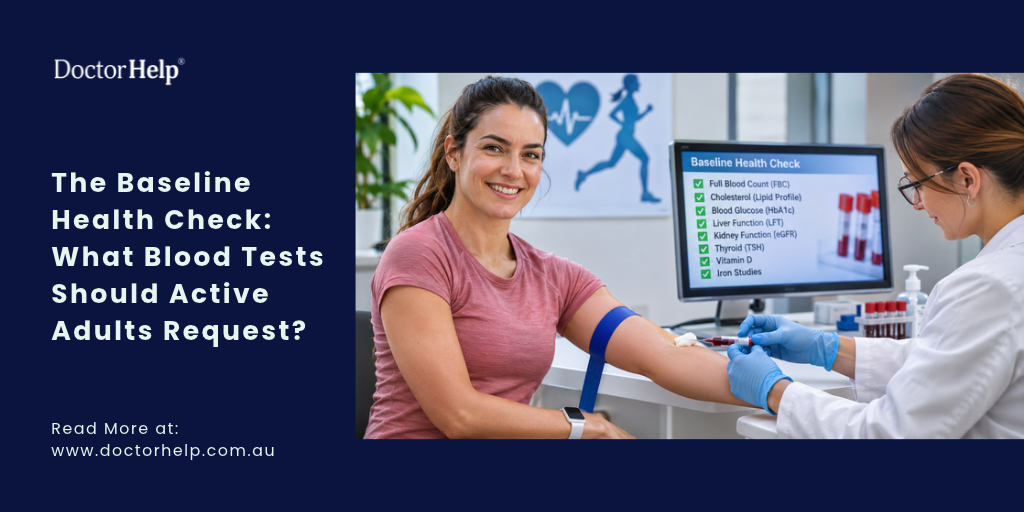
- Full blood count: Can help investigate problems such as anaemia and certain blood disorders.
- Kidney and liver function tests: May help assess organ function when clinically indicated.
- Iron studies: Can help investigate suspected iron deficiency, particularly when symptoms or dietary history raise concern.
- Blood glucose or HbA1c: May help assess blood sugar levels and diabetes risk.
- Lipid profile: Measures blood fats and may contribute to an assessment of cardiovascular risk.
These tests are examples, not a checklist that everyone needs. The RACGP’s preventive health guidance supports an individualised approach to screening and risk assessment rather than indiscriminate testing. Other investigations, including thyroid function or hormone tests, may be considered when the clinical picture supports them.
Where telehealth helps, and when in-person care matters
Telehealth can be a convenient way to discuss health concerns, review relevant history and explore whether pathology testing may be appropriate. However, some concerns require a physical examination, additional investigations or face-to-face assessment. A doctor may recommend an in-person appointment when symptoms are difficult to assess remotely or when further investigation is needed.
Once results become available, follow-up is also important. A result outside a laboratory’s reference range does not automatically mean something is wrong, and a result within that range does not necessarily rule out every health concern. Interpretation depends on the person’s circumstances and the reason for testing.
Your health is more than a set of numbers
It can be frustrating when you’re putting effort into your health but still don’t feel quite like yourself. Perhaps your usual workouts feel harder, your recovery takes longer, or you simply want to understand your body a little better. Those concerns deserve a thoughtful conversation, not necessarily a longer list of blood tests.
Sometimes, it is sensible to step back and focus on the wider context such as how you are sleeping, eating, coping with stress, training as well as the observations you’ve made. Blood tests may be helpful when there is a clear reason to investigate further, and a doctor can help you work out which tests, if any, are appropriate for your circumstances.
There’s no need to chase every health marker to take your wellbeing seriously. A measured approach can help you focus on what matters to you and make informed decisions without adding unnecessary worry.
To discuss your symptoms, training goals and whether pathology testing may be appropriate, you can speak with an Australian doctor online through Doctor Help and explore suitable next steps.
Disclaimer: This article provides general health information only and is not a substitute for individual medical advice. Seek emergency care for symptoms such as chest pain, difficulty breathing, collapse or sudden severe symptoms. For persistent fatigue, unexplained changes in health or other ongoing concerns, arrange a medical assessment rather than relying on self-directed testing.
References:
- Guide to blood testing. (n.d.). All You Need to Know About Having a Blood Test | Healthdirect.
https://www.healthdirect.gov.au/procedures/diagnostic-tests-and-scans/blood-tests/blood-testing - Pathology services for health professionals. (2025, September 15). Services Australia.
https://www.servicesaustralia.gov.au/pathology-services-for-health-professionals?context=20& - RACGP – about the Red Book. (n.d.).
https://www.racgp.org.au/clinical-resources/clinical-guidelines/key-racgp-guidelines/view-all-racgp-guidelines/preventive-activities-in-general-practice/about-the-red-book - Refer or request Medicare services. (2026, July 1). Services Australia.
https://www.servicesaustralia.gov.au/refer-or-request-medicare-services?context=20#accordion1 - Testosterone blood test. (n.d.). How to Prepare for Your Blood Test | Healthdirect.
https://www.healthdirect.gov.au/procedures/diagnostic-tests-and-scans/blood-tests/testosterone-test - Vitamin B12 test. (n.d.). Healthdirect.
https://www.healthdirect.gov.au/procedures/diagnostic-tests-and-scans/blood-tests/vitamin-b12-test - Vitamin D test. (n.d.). Healthdirect.
https://www.healthdirect.gov.au/procedures/diagnostic-tests-and-scans/blood-tests/vitamin-d-test
Reviewed By: Dr. Momal Ahmad.