Table of Contents
You know the breakout before it even arrives.
That sore little pressure under the skin. Usually on the chin. Sometimes along the jaw. It does not look like much at first, but you can feel it coming. A few days later, it is swollen, painful, and sitting exactly where it did last month.
So you do what most people do.
You change your cleanser. You stop using that moisturiser. You buy the serum with the good reviews. You try pimple patches, acids, barrier repair creams, “non-comedogenic” everything. Maybe you start wondering if your pillowcase is dirty, or your makeup is wrong, or your skin is somehow just difficult.
After a while, it gets exhausting.
Not because skincare is silly. It is not. Good skincare matters.
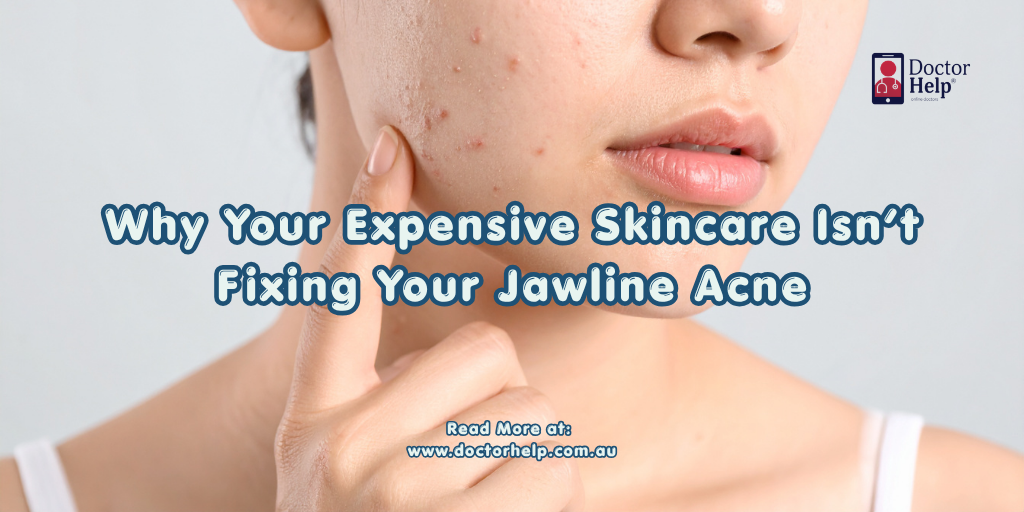
But if the same deep jawline acne keeps returning, especially in your late 20s, 30s or 40s, the problem may not be the cleanser at all.
It may be hormonal.
And hormonal acne does not care how expensive your face wash was.
The giveaway is often the pattern
Adult acne does not always behave like teenage acne.
Teenage acne often spreads across the forehead, nose, cheeks, chest or back. Adult acne in women often has a different rhythm. It likes the lower face. Chin. Jawline. Neck. Lower cheeks.
It may flare before a period. It may appear after stopping the pill. It may become worse during stress. It may show up after pregnancy, during perimenopause, or after years of mostly clear skin.
And it is often deeper.
Not always, but often.
The kind of spot that hurts before it has a head. The kind you cannot really “dry out” because it feels like it is sitting underneath the skin. The kind that leaves a mark long after the swelling settles.
That pattern is worth paying attention to.
A random pimple is just a random pimple. Repeated painful breakouts around the jawline are telling you something different.
It is probably not because your skin is dirty
This needs to be said clearly.
Adult jawline acne is usually not a hygiene failure.
Most women dealing with this are already doing too much, not too little. They are cleansing, exfoliating, masking, spot treating, cutting foods, changing products, and blaming themselves every time a new lump appears.
But acne is not simply “dirty skin”.
Acne develops when oil, dead skin cells, bacteria and inflammation get trapped inside the follicle. Hormones can push that process by increasing oil production. Androgens — hormones that women also naturally have — can make oil glands more active. Some women have higher androgen levels. Others may have normal levels but skin that is more sensitive to them.
Either way, the result can look the same from the outside: deep, stubborn acne that keeps coming back.
So no, washing your face harder is not the answer.
In fact, overwashing can make things worse.
Where PCOS comes into the picture
Jawline acne does not automatically mean PCOS.
But it can be one of the clues.
PCOS, or polycystic ovary syndrome, is a common hormonal condition. Despite the name, it is not just about cysts on the ovaries. It can involve irregular ovulation, androgen activity, insulin resistance and metabolic changes.
Some women with PCOS have very obvious symptoms. Others do not.
Acne may be part of the picture if it comes with things like irregular periods, long gaps between periods, increased facial hair, thinning hair on the scalp, oily skin, difficulty losing weight, weight around the middle, or sugar cravings.
Some women have spent years treating the skin and never had anyone ask about their cycle.
That is the problem.
Skin does not live separately from the rest of the body. A face full of expensive skincare products cannot answer questions about hormones, ovulation, insulin resistance or androgen sensitivity.
A proper assessment can.
The beauty aisle can become a trap
There is a product for everything now.
One for texture. One for redness. One for pores. One for barrier repair. One for acne marks. One for active pimples. One for preventing the pimples you do not even have yet.
It is easy to feel like the next product will finally be the one.
Sometimes products help. A simple routine can reduce irritation and support the skin. Ingredients like benzoyl peroxide, azelaic acid, salicylic acid or topical retinoids can be useful for acne, depending on your skin and the severity.
But a product can only do what a product can do.
A cleanser cannot check testosterone.
A serum cannot rule out PCOS.
A moisturiser cannot treat a hormonal driver.
And a $90 bottle with nice packaging is still just skincare.
That sounds harsh, but it is better than spending another six months blaming yourself.
When skincare is not enough
You do not need to run to a doctor for every breakout.
But there are signs the problem deserves more than another product change.
Medical advice is worth considering if the acne is deep, painful, cystic, recurring in the same lower-face areas, leaving scars or dark marks, flaring around your cycle, or not improving after a solid 8 to 12 weeks of consistent treatment.
It is also worth getting checked if acne comes with irregular periods, facial hair growth, scalp hair thinning, sudden weight changes, difficulty losing weight, or symptoms that make you wonder about PCOS.
And there is another reason to take it seriously: acne affects people emotionally.
Not in a shallow way. In a real way.
Painful acne changes how you feel walking into a room. It changes whether you want photos taken. It changes how much makeup you wear, how you date, how you show up at work, how closely you let people look at your face.
So if it is affecting your confidence, that counts too.
What a doctor may actually look for
A decent acne assessment is not just someone glancing at your chin and handing you a cream.
The pattern matters.
When did it start?
Is it always lower face?
Does it flare before your period?
Are your cycles regular?
Have you changed contraception?
Any facial hair growth?
Any hair thinning?
Any major stress, pregnancy, breastfeeding or weight changes?
Any medications or supplements?
Any scarring?
Sometimes the next step is prescription acne treatment. Sometimes it is blood tests. Sometimes it is both.
If hormones or PCOS are suspected, a doctor may consider checking androgen markers such as testosterone or DHEAS. Depending on the story, they may also think about thyroid testing, blood sugar markers, cholesterol, or other hormone-related checks.
Not everyone needs a hormone panel.
But if the symptoms are pointing in that direction, testing can stop the guessing.
Prescription treatment is not a failure
Some people feel disappointed when skincare is not enough, as if needing medical treatment means they failed.
It does not.
Acne is a medical condition. Sometimes it needs medical treatment.
Depending on the type and severity, options may include topical retinoids, benzoyl peroxide combinations, topical or oral antibiotics, hormonal contraception in suitable patients, or anti-androgen medications in selected cases.
Severe, scarring or persistent acne may need a dermatologist.
The right treatment depends on the person. Pregnancy plans matter. Breastfeeding matters. Migraine history, clot risk, medications, mood history, skin type, severity and previous treatments all matter.
That is why copying someone else’s acne routine from TikTok is risky.
Their acne may look like yours and still not be the same problem.
The part nobody says enough
You can be doing everything right and still have acne.
You can eat well, wash your face, drink water, change pillowcases, use sunscreen, avoid heavy makeup, and still get painful jawline breakouts.
That does not mean your body is broken.
It means the cause might be deeper than the surface.
And sometimes the most useful move is not adding more to your routine. It is simplifying the noise and getting a proper explanation.
Your skin may be giving you useful information
Jawline acne is frustrating because it feels visible and hidden at the same time.
Visible on your face.
Hidden in its cause.
Maybe it is androgen sensitivity. Maybe it is PCOS. Maybe it is stress, contraception changes, insulin resistance, thyroid imbalance, or simply persistent adult acne that needs prescription treatment rather than another cosmetic product.
The point is not to panic over every breakout.
The point is to notice the pattern.
If the same painful acne keeps returning along your jawline or chin, and especially if it comes with cycle changes or other hormonal signs, it is reasonable to ask a better question than “What product should I buy next?”
Ask what your skin is trying to tell you.
That question may save you money, time, and a lot of unnecessary self-blame.
Disclaimer:
This article provides general information only and does not replace personal medical advice. Acne, hormonal symptoms and possible PCOS should be assessed by a qualified healthcare professional. Testing, diagnosis and treatment decisions depend on individual clinical assessment. Some acne treatments are not suitable during pregnancy or when trying to conceive.
References:
- Healthdirect Australia — Acne
Acne treatments | healthdirect - RACGP — Polycystic ovary syndrome guidance
https://www.racgp.org.au/afp/2012/october/polycystic-ovary-syndrome - DermNet — Acne treatments
https://dermnetnz.org/topics/acne-treatment
Reviewed By: Dr. Momal Ahmad.