Table of Contents
You’ve tried the antacids. You’ve cut back on coffee, propped up your pillow, given up tomato sauce for a fortnight out of sheer desperation. And still, that burning creeps back most evenings like clockwork. When heartburn won’t go away no matter what you throw at it, it’s worth asking a slightly different question: what if this was never just reflux to begin with?
In this article, we’ll walk through when persistent indigestion points toward something bacterial rather than dietary, what an H. pylori test actually involves, why the timing of that test matters more than most people realise, and when it’s worth seeing someone in person rather than pushing through alone.
H. pylori Symptoms Causes
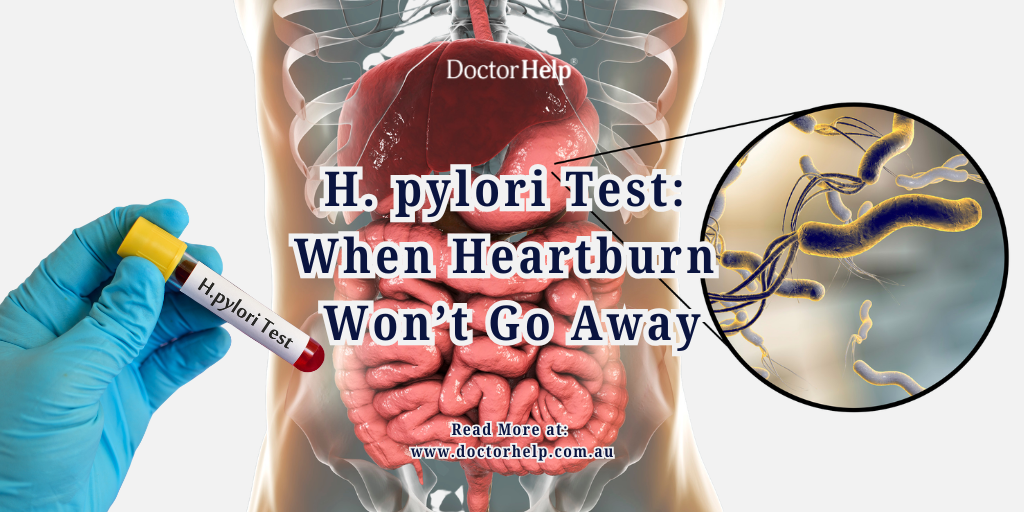
Helicobacter pylori, usually just called H. pylori, is a curved spiral-shaped bacterium that burrows into the mucus lining of the stomach, which is a fairly unusual trick given how acidic that environment normally is. Most people pick it up in childhood, usually through close contact within a household, contaminated food or water, or shared utensils and cups. It is usually spread through close contact and contaminated food or water. It tends to settle in quietly over time, often from someone else in the family who’s carrying it without knowing.
Once it’s there, the bacteria can trigger low-grade inflammation in the stomach lining, known as gastritis, which is often the starting point for everything else that follows. Not everyone notices a thing. In fact, plenty of people go their whole lives with H. pylori present and never develop a single symptom.
For those who do, H. pylori symptoms tend to show up gradually rather than all at once, and often include:
- A burning or gnawing pain in the upper stomach, sometimes worse on an empty stomach
- Bloating or a feeling of fullness that lingers well after eating
- Nausea, and occasionally vomiting
- A reduced appetite, or feeling full much faster than usual
- Frequent burping or reflux that doesn’t respond to the usual remedies
When Heartburn Might Be More Than Simple Reflux
H. pylori is far more common than most people assume. According to Healthdirect Australia, roughly three in every ten Australian adults are estimated to carry it, with higher rates among Aboriginal and Torres Strait Islander peoples and people who grew up in regions where it spreads more easily.
For others, though, it stirs up genuine trouble. H. pylori symptoms tend to look a lot like ordinary indigestion at first glance: a gnawing or burning pain in the upper stomach, bloating, nausea, an appetite that’s gone missing, or reflux that keeps resurfacing no matter how carefully you eat. The overlap with plain old reflux is exactly why it gets missed so often. If you’ve been treating “just heartburn” for weeks with over-the-counter remedies or a script for acid suppression and you’re still not right, that’s less a sign you’re doing something wrong and more a sign it may be time to look for a cause rather than just managing the symptom.
Left alone, this bacterium can quietly cause inflammation of the stomach lining, and in some people, it plays a role in stomach ulcers. Treating the infection heals most peptic ulcers linked to it and also lowers the long term risk of stomach cancer, which is really the whole point of testing rather than just guessing.
Read: Signs Your Gut Microbiome Is Unbalanced
Which H. pylori Test Checks Active Infection
Not every H. pylori test tells you the same thing, and this trips a lot of people up. A blood test looks for antibodies, but antibodies can stick around long after the bacteria are gone, so a positive result doesn’t necessarily mean you’re currently infected. It’s a bit like finding an old parking ticket in the glovebox. It tells you something happened once, not whether it’s still an issue.
For an accurate read on whether the infection is active right now, doctors generally lean on two options instead. The h pylori breath test patients typically encounter involves swallowing a small amount of liquid or a capsule containing a specific form of carbon, then breathing into a collection device a short time later. It’s non-invasive, well tolerated, and considered accurate for confirming an active infection.
The more practical alternative is the H pylori stool test for children or anyone who’d rather skip the breath test altogether, which examines a stool sample for antigens, known to be essentially pieces of the bacteria itself.
Where symptoms are more concerning, or there’s a family history of stomach cancer, your doctor may also suggest an endoscopy, where a thin camera is passed down to look at the stomach lining directly and take a small tissue sample if needed.
Why PPIs and Antibiotics Can Confuse the Result
This is the part that catches even conscientious patients out. If you’ve been taking a proton pump inhibitor for your reflux, and let’s be honest, most people self-treating heartburn have, it can suppress the bacteria just enough to throw off a breath or stool test, even when the infection is still there. Doctors generally recommend stopping PPIs for around two weeks beforehand to reduce the chance of a false negative, and recent antibiotic or bismuth use can distort results too, so your doctor may ask you to hold off for a few weeks before testing.
None of this means you need to white-knuckle through untreated heartburn while you wait. It simply means the timing needs a bit of planning, and it’s worth having that conversation with whoever orders your test rather than assuming any day will do.
Once H. pylori treatment does start, it’s usually a short course combining antibiotics with an acid-suppressing medication, aimed at clearing the bacteria entirely rather than just calming symptoms for a while. Confirming the infection is actually gone typically involves retesting about four weeks after finishing treatment, since checking too early can give a misleadingly reassuring result.
When Telehealth Can Arrange Testing
For a lot of people, the hardest part isn’t the test itself, it’s finding the time to sit in a waiting room to get referred for one. A telehealth consultation can genuinely help here. A doctor can talk through your symptoms, ask about how long the heartburn has been going on and what you’ve already tried, and arrange a pathology referral for a breath or stool test at a collection centre near you, all without you needing to take half a day off work first.
Telehealth has its limits, of course. If an endoscopy turns out to be the right next step, that requires an in-person referral and a specialist to actually perform it. And if your symptoms tick any of the boxes below, a screen simply isn’t the right tool for the job.
Red Flags That Need Urgent In-Person Care
Most persistent heartburn is uncomfortable rather than dangerous, but a handful of h pylori symptoms deserve prompt, in-person medical attention rather than a wait-and-see approach:
- Vomiting blood, or vomit that looks like coffee grounds
- Black, tarry stools, which can indicate bleeding higher up in the digestive tract
- Unexplained or unintentional weight loss
- Difficulty or pain swallowing food
- Persistent vomiting that won’t settle
If any of these show up alongside your heartburn, it’s genuinely worth being seen the same day rather than booking around your schedule. Depending on what’s found, this might also mean additional tests such as a full blood count if anaemia or bleeding is suspected, iron studies if blood loss looks ongoing, or a referral for endoscopy to see what’s actually happening rather than guessing from symptoms alone.
Persistent heartburn deserves more than another round of antacids and hope. If yours has been hanging around longer than it should, it might be worth finding out what’s actually behind it rather than just outlasting it. If that sounds like where you’re at, a consultation can help you talk through whether testing makes sense for you.
References:
- Healthdirect Australia. (n.d.). Helicobacter pylori. Healthdirect.
https://www.healthdirect.gov.au/helicobacter-pylori - Helicobacter Pylori. (n.d.). Johns Hopkins.
https://www.hopkinsmedicine.org/health/conditions-and-diseases/helicobacter-pylori - Sankararaman, S., & Moosavi, L. (2024, February 23). Urea breath test. StatPearls – NCBI Bookshelf.
https://www.ncbi.nlm.nih.gov/books/NBK542286/ - Helicobacter pylori » Australian Refugee Health. (n.d.).
https://refugeehealthguide.org.au/helicobacter-pylori/ - Helicobacter pylori (H. pylori) infection. (2025, December). Mayo Clinic.
https://www.mayoclinic.org/diseases-conditions/h-pylori/symptoms-causes/syc-20356171
Reviewed By: Dr. Momal Ahmad.