Table of Contents
Your kid’s been up since 3am, the thermometer keeps climbing, and you’re mentally rehearsing how you’re going to explain to your manager that today simply isn’t happening. Somewhere underneath all of that sits a quieter worry: the paperwork, because most workplaces expect a bit more than a text message saying you won’t be in. Getting proof sorted for work is probably the last thing you have energy for right now, and it shouldn’t need to involve dragging a feverish toddler into a waiting room full of other sick people.
If you’re trying to work out whether a carer’s leave certificate online can actually hold up with HR, and whether Fair Work backs that up, you’re asking exactly the right question at exactly the wrong moment. So here’s the straightforward version of how an online carer’s leave certificate works in Australia, so you can get back to the person who actually needs you.
Can an Online Doctor Issue a Carer’s Leave Certificate?
An online doctor may issue you a carer’s certificate depending on the circumstances and the doctor’s assessment. This is a legitimate and increasingly common way to get one. Telehealth consultations that result in medical certificates, including carer’s certificates, are a recognised part of how AHPRA-registered practitioners provide care, provided the doctor has done a proper clinical assessment rather than just rubber-stamping a request. So can an online doctor give a carer’s certificate the same way an in-person GP would? In most cases, yes, as long as the consultation is genuine and real-time and the doctor has enough information to decide whether issuing the certificate is appropriate.
What the Fair Work Act Says About Taking Leave to Care for Family
Under the National Employment Standards, most employees are entitled to take personal/carer’s leave to care for or support an immediate family or household member who’s dealing with an illness, injury, or unexpected emergency. Full-time employees generally accrue 10 days of paid personal/carer’s leave per year, while part-time employees accrue it on a pro-rata basis. Casual employees generally do not receive paid personal/carer’s leave but may be entitled to unpaid carer’s leave.
This is where Fair Work’s evidence requirements become relevant. Under section 107 of the Fair Work Act, your employer can ask for evidence that would satisfy a reasonable person that your leave was genuine, and a medical certificate is one example of evidence that may satisfy this requirement. Importantly, this evidence requirement doesn’t mean your employer is entitled to a full diagnosis or a breakdown of your family member’s medical history. Employers generally do not need detailed clinical information beyond what is reasonably necessary to establish the leave entitlement. A certificate or other evidence confirming that you needed to provide care or support during the relevant period is generally what’s expected. The exact evidence requirements may also depend on your workplace policy, modern award or enterprise agreement.
Read: 4 Major Purposes Of Online Medical Certificate In Australia
Does the Sick Family Member Need to Be on the Telehealth Call?
This one depends a bit on the situation, so it’s worth being upfront rather than promising a one-size-fits-all answer. Sometimes a doctor can reasonably assess the caring need from your description alone, particularly if you’re clearly describing symptoms, behaviour, or a situation that makes the need for care obvious. Other times, especially with a medical certificate for sick child online requests, the doctor may want to see or briefly speak with the child directly. Children may not always be able to explain their symptoms fully, so this additional information can help the doctor assess the situation and decide whether a certificate is appropriate. If your doctor asks to speak with or see your child, this is part of gathering enough information to provide safe and appropriate care.
Will My Employer Accept an Online Carer’s Certificate?
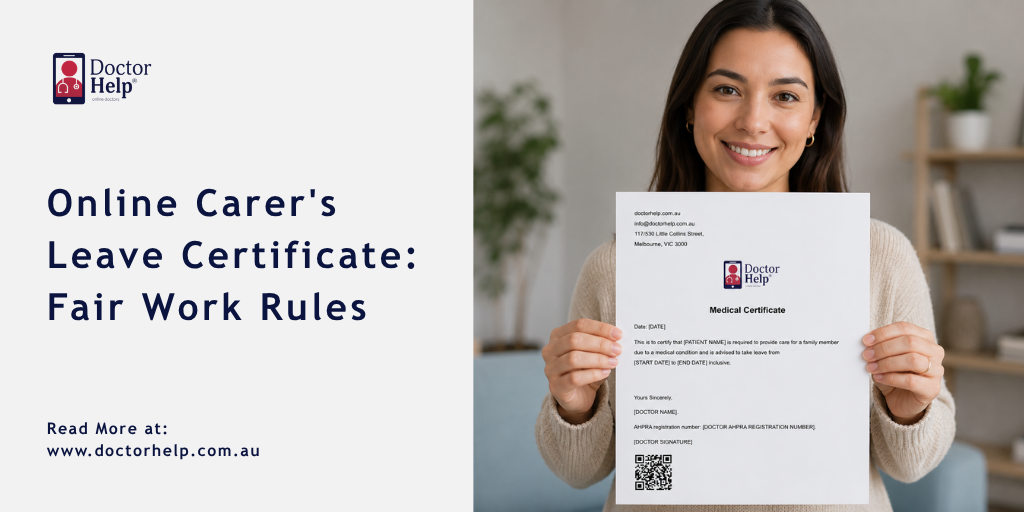
Generally, yes, provided it comes from a genuine, real-time consultation with an AHPRA-registered practitioner and clearly states what’s needed, the dates involved, and that care or support was required. There’s nothing in the Fair Work Act that requires evidence to come from an in-person visit specifically, what matters is that it would satisfy a reasonable person that the leave was genuine. That said, individual workplace policies can occasionally ask for specific formats, so it’s worth glancing at your own employer’s leave policy if you’re not sure.
Who Qualifies as an “Immediate Family Member”?
This trips people up more often than you’d expect, mostly because the definition is broader than most people assume. Under the Fair Work Act, immediate family generally includes a spouse or de facto partner, child, parent, grandparent, grandchild or sibling, as well as the equivalent relatives of a spouse or de facto partner. On top of that, household members are also covered, even if they’re not related to you at all.
Also read: Understanding Caregiver Stress: Top 5 Tips for Success
When an Online Sick Note for Your Child Might Not Be Enough
Telehealth may be suitable for some everyday situations, such as a feverish child, a stomach bug or a partner recovering from a minor procedure. Where it reaches its limits is when the family member’s condition needs an actual physical examination to properly understand what’s going on, or when something looks more serious than a routine illness. If you’re describing symptoms that sound concerning, difficulty breathing, unusual drowsiness or confusion, a good telehealth doctor will likely suggest an in-person review rather than issuing a certificate and leaving it there. That’s not the system failing you, that’s it working the way it should.
Urgent note: If the person you’re caring for is a baby under 3 months old and has a fever, seek urgent in-person medical care immediately. Telehealth is not suitable in that situation.
How to Request an Online Carer’s Certificate With Doctor Help
Nobody wants to be filling out paperwork while they’re juggling a sick kid, a worried partner, or a stressed household. A telehealth consultation for a carer’s certificate should feel like the easy part of a hard day, not one more hurdle. If you need proof sorted for work while you’re at home looking after someone who needs you, you can book a consultation through Doctor Help to get it handled without leaving the house.
Disclaimer: This article is general information only and does not replace individual medical or legal advice. A carer’s certificate confirms the need for care and support; it is not a diagnosis.
References:
- Patient safety paramount in updated telehealth guidance. (2025, October 7). AHPRA & National Boards.
https://www.ahpra.gov.au/News/2025-10-07-Updated-telehealth-guidance.aspx - National employment standards: Personal/Carer’s leave, compassionate leave and family and domestic violence leave. (2025). In Fair Work Commission.
https://www.fwc.gov.au/documents/resources/nes-personal-and-carers-leave.pdf - Notice and medical certificates. (n.d.). Fair Work Ombudsman.
https://www.fairwork.gov.au/leave/sick-and-carers-leave/paid-sick-and-carers-leave/notice-and-medical-certificates - Sick and Carer’s Leave and Compassionate Leave fact sheet. (n.d.). Fair Work Ombudsman.
https://www.fairwork.gov.au/tools-and-resources/fact-sheets/minimum-workplace-entitlements/sick-and-carers-leave-and-compassionate-leave
Reviewed By: Dr. Momal Ahmad.