Table of Contents
Some pain arrives with no explanation attached. One day your ribs feel bruised even though nothing hit them, or a strip of skin on your back stings like it’s been sitting too close to a fire. Most people brush it off as a pulled muscle or a bad night’s sleep, right up until a rash shows up and rewrites the whole story. By then, the clock on treating it well has already started ticking.
That clock is the whole story with shingles treatment. Get the timing right, and you can genuinely change how rough the next few weeks look. Get it wrong, and you are left managing consequences that could have been softened considerably.
What Causes Shingles
Shingles happens when the varicella zoster virus, the same virus responsible for chickenpox, reactivates inside the body. Once you have had chickenpox, the virus does not fully leave. It retreats into nerve tissue and lies dormant, sometimes for decades, until something, often a dip in immune function that comes naturally with age, illness, or certain medications, gives it the opening to flare back up as shingles. This is precisely why the condition becomes far more common from age fifty onward, and why anyone with a weakened immune system carries a higher risk regardless of age.
What Shingles Feels Like Before the Rash Appears
Nobody tells you this part. Before any rash appears, shingles almost always gives you notice: a stretch of one to three days where the skin over a specific area starts feeling tender, itchy, or oddly hot to the touch. For some, this initial “prodrome” can also include headache, a mild fever or light sensitivity, and it’s so subtle you could be ignoring it.
The significance of catching these early shingles symptoms really matters as they often are unilateral, that is, confined to one side of the body, a band across the ribs, a strip down an arm, a patch on the scalp, following the path of a single nerve. That one sided pattern is a useful clue in itself. After years of dormancy, virus travels along the single nerve pathway that it’s inhabiting, hence the pain generally remains localized, rather than a widespread outbreak.
What Does Shingles Look Like
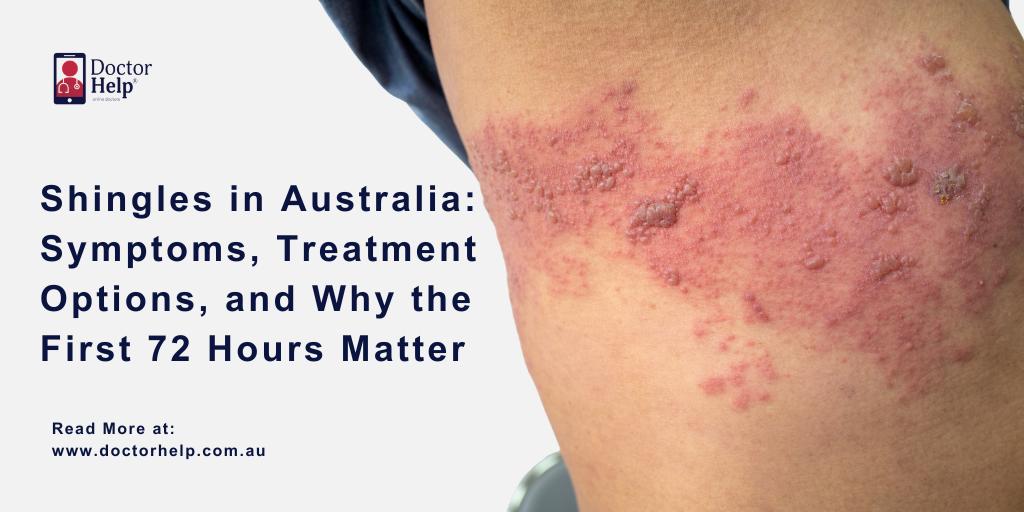
Once the rash itself shows up, people often ask what shingles look like, and the honest answer is that it changes day by day. It starts as small, tender red bumps, and within a day or two those bumps swell into clusters of fluid filled blisters, usually forming a band like pattern that has earned shingles its old, rather theatrical nickname among clinicians. The shingles rash typically runs its course over ten to fifteen days, often leaving a scaly crust behind before the skin gradually settles back to normal.
While we are here, it is worth answering something people quietly wonder about but rarely say out loud: is shingles contagious? Not in the way you might expect. You cannot catch shingles from someone else who already has it. What can happen is that a person who has never had chickenpox, or the chickenpox vaccine, could catch chickenpox from direct contact with fluid from your blisters. This is exactly why keeping the rash covered is not just about your own comfort, it is a small, considerate act of protection for the people around you.
Why the First 72 Hours Matter
Here is the part that deserves to be said plainly, because it genuinely changes outcomes. Starting antiviral medicine within three days of the rash appearing, and ideally within the first 24 hours, can meaningfully reduce the severity of symptoms and the risk of longer term complications.
Miss that window, and your antiviral medicine loses some of its power to mute the attack, although your physician might still prescribe it for longer than three days under specific conditions, like new blisters continuing to erupt or if you’re among those considered high-risk for more complications. There is no cure for shingles itself, no single treatment that erases the virus outright, but there is a genuine, evidence backed opportunity to shorten the ordeal and lower your odds of dealing with nerve pain that outlasts the rash by months or, in some cases, years. That lingering pain has a clinical name, post herpetic neuralgia, and it affects roughly one in ten people who have had shingles, more often those over fifty.
Who Is More Likely to Need Antiviral Treatment
Age plays a major role here. Risk of complications climbs steadily from fifty onward, and climbs further still past sixty five. Aboriginal and Torres Strait Islander people aged fifty and over face elevated risk as well, alongside anyone whose immune system is compromised through illness, transplant medication, or other immune suppressing treatment. If you sit in any of these groups, it’s wise not to wait and see whether the rash settles on its own before speaking to a doctor, since earlier treatment tends to work better than later treatment.
Pregnant women deserve a specific mention here. Antivirals can be appropriate during pregnancy, but this is a conversation to have directly with your doctor, not a decision to make from a search result, given the additional care pregnancy always calls for.
When Telehealth Can Help and When It Cannot
For a large share of cases, a video consultation is a genuinely sensible first move, and it may well be the fastest option available to you. A doctor can look at your rash over video, ask about the timeline of your symptoms, and, where clinically appropriate, get things moving without you needing to sit in a waiting room feeling wretched. Given how much the first three days matter for shingles treatment, Australian guidelines actually prioritise timely antiviral review. Telehealth can be one way to achieve that speed.
Telehealth has limits though, and pretending otherwise would do you a disservice. Anything involving the eye, the face, or signs of more serious nerve involvement needs a set of hands and proper equipment in the room with you, not only a camera. The same goes for pain that simply will not respond to anything you have tried, or a rash spreading well beyond what feels like a single, contained patch.
Red Flags: Eye Symptoms, Facial Rash, Pregnancy, Immune Suppression
A few situations call for urgent, in person attention rather than a wait and see approach.
- Rash near the eye or on the tip of the nose, which can threaten vision and needs same day assessment, often with a referral to an eye specialist
- Facial drooping, ear pain, hearing changes, or dizziness, which can signal a more serious variant involving the facial nerve
- Pregnancy, which always warrants a direct conversation with your doctor about which antiviral, if any, is suitable
- A weakened immune system, since shingles can behave more aggressively and repeat episodes are more common in this group
Prevention is worth a mention too, since it is the one part of this story you can act on before anything starts aching in the first place. The shingles vaccine is funded under Australia’s National Immunisation Program for people aged 65 and over, Aboriginal and Torres Strait Islander people aged 50 and over, and certain immunocompromised groups, given as a two dose course that meaningfully lowers your lifetime odds of ever having this particular conversation with yourself at 2am.
Key Takeaways
Shingles is the kind of condition where timing can make a noticeable difference to how you feel. If a patch of skin has started aching, tingling, or blistering and those first 72 hours are on your mind, it’s worth getting it looked at rather than searching for answers alone. You can book a consultation through Doctor Help, where our specialists can help you manage it earlier rather than later.
Disclaimer: This article is general information only and does not replace individual medical advice. Shingles can look deceptively similar to other skin conditions in its early stages, and only a proper clinical assessment can confirm what you are dealing with.
References:
- Healthdirect Australia. (2025, September 16). Shingles. Treatments, Symptoms and Causes | Healthdirect.
https://www.healthdirect.gov.au/shingles - Protocol for Management of Herpes Zoster shingles. (2024). In the Department of Health.
https://www.health.vic.gov.au/sites/default/files/2024-02/protocol-for-management-of-herpes-zoster-shingles.pdf - Florid pustular eruption in an adult man. (n.d.). Australian Journal of General Practice.
https://www1.racgp.org.au/ajgp/2024/april/florid-pustular-eruption-in-an-adult-man - Postherpetic neuralgia. (2026, July 10). Mayo Clinic.
https://www.mayoclinic.org/diseases-conditions/postherpetic-neuralgia/symptoms-causes/syc-20376588 - Shingles (herpes zoster). (2025, December 9). Australian Centre of Disease Control.
https://www.cdc.gov.au/diseases/shingles-herpes-zoster - Practice standards herpes zoster. (2025).
https://www.health.nsw.gov.au/pharmaceutical/pharmacists/Documents/practice-standards-herpes-zoster.pdf - National Immunisation Program – Shingles program. (2024).
https://www.health.gov.au/sites/default/files/2024-11/national-immunisation-program-shingles-vaccination-program-advice-for-health-professionals.pdf
Reviewed By: Dr. Momal Ahmad.