Table of Contents
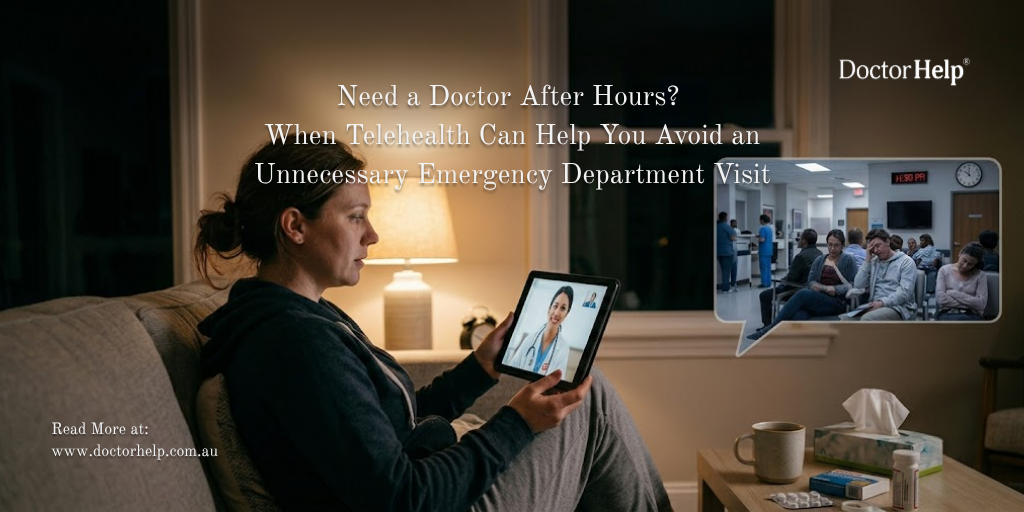
Let’s be honest, people rarely get sick at a convenient time.
It’s not usually 10:00 am on a Tuesday when your GP has a free appointment and the clinic is running on schedule. More often, it’s 7:30 pm on a Friday. Or Sunday afternoon. Or the night before work when your throat suddenly feels worse, your child has a temperature, or you realise your prescription has run out.
And then comes the question nobody wants to ask:
“Do I really need to go to hospital for this?”
Sometimes, yes. Absolutely.
If something feels serious, sudden, severe, or frightening, the emergency department is the right place to be. But for many minor illnesses and non-emergency health concerns, sitting for hours in a hospital waiting room may not be the only option anymore.
That’s where after-hours telehealth can make a real difference.
The Problem With Getting Sick After Hours
Most local GP clinics still work around normal business hours. Some open on Saturday mornings. Many close by late afternoon. Sunday appointments can be hard to find. Public holidays are even worse.
But illness doesn’t really care about opening hours.
A urinary symptom can flare up after dinner. A rash can appear before bed. A cough can become worrying on a weekend. A parent can spend half the night wondering whether their child needs a doctor now or can wait until Monday.
That uncertainty is often the worst part.
You’re not always sick enough to call an ambulance. But you’re also not comfortable doing nothing. So the hospital starts to feel like the only option, even when deep down you know it may not be the best place for a minor issue.
After-hours care exists for that exact middle ground.
When You Should Go to Emergency
Before anything else, safety matters.
Telehealth is not for emergencies. It is not a replacement for hospital care, ambulance services, or urgent physical assessment.
You should call 000 or go to your nearest emergency department if you or someone in your care has symptoms such as:
- chest pain
- severe breathing difficulty
- signs of stroke
- severe allergic reaction
- heavy bleeding
- serious injury
- sudden severe pain
- collapse, confusion, or loss of consciousness
- a seizure
- symptoms that are rapidly worsening
- anything that feels life-threatening
No online doctor should try to manage those situations through a screen.
If your body is telling you something is seriously wrong, listen to it.
But Not Every Health Concern Belongs in Hospital
Here’s the part people don’t always talk about.
Emergency departments are designed for urgent and serious medical problems. They treat patients based on how unwell they are, not who arrived first.
That means if you turn up with a minor infection, mild symptoms, or a non-life-threatening concern, you may wait a long time. And that’s not because anyone is ignoring you. It’s because the person with chest pain, breathing trouble, major injury, or stroke symptoms has to come first.
That is exactly how emergency care should work.
But it also means many people with less urgent problems spend hours waiting, tired, uncomfortable, and wondering whether there was another way.
Sometimes there is.
What After-Hours Telehealth Can Help With
After-hours telehealth can be useful when the issue is uncomfortable, inconvenient, or worrying, but not an emergency.
For example, you may want to speak with a doctor about:
- cold and flu symptoms
- sore throat
- mild respiratory symptoms
- urinary symptoms
- minor skin rashes
- simple medication questions
- repeat prescription requests
- medical certificates after assessment
- general health advice
- whether you need in-person care
The key is suitability.
Some things can be safely assessed through a phone or video consultation. Some things cannot. A good telehealth doctor will tell you when online care is not enough.
That’s not them brushing you off. That’s them doing their job properly.
The Friday Night UTI Problem
A good example is a possible urinary tract infection.
If someone develops burning, frequency, or discomfort late on a Friday, waiting until Monday can feel miserable. But going to an emergency department for a mild, uncomplicated concern may also feel excessive.
In some cases, a telehealth consultation may help the doctor assess symptoms, ask the right questions, check for red flags, and decide whether treatment, testing, or in-person care is needed.
But if there is fever, flank pain, vomiting, pregnancy, severe pain, blood in the urine, or other warning signs, the doctor may recommend urgent in-person care instead.
That is the balance telehealth needs to get right.
Helpful, but not reckless.
Why Weekend Telehealth Matters
Weekends are when healthcare access often feels hardest.
You can’t get your regular GP. The clinic phone goes to voicemail. The pharmacy may still be open, but you need a prescription first. Your child is unwell, and you’re trying to decide whether to wait, worry, or pack everyone into the car.
This is where weekend telehealth has become genuinely useful.
Not because it replaces your regular doctor.
It doesn’t.
Your regular GP is still important for ongoing care, chronic conditions, preventive health, and anything complex. But for everyday, non-emergency concerns, being able to speak with an Australian-registered doctor after hours can take away a lot of stress.
Sometimes what people need most is not a hospital bed.
Sometimes they need a doctor to say, “This sounds manageable,” or “No, this needs to be seen tonight.”
Both answers are valuable.
What About Urgent Care Clinics?
Australia now has more options between “wait for your GP” and “go to emergency.”
Medicare Urgent Care Clinics are one example. They are designed for urgent but non-life-threatening problems, the sort of things that need care but may not need a hospital emergency department.
That includes issues like minor infections, mild burns, sprains, cuts, bites, rashes, respiratory illness, gastroenteritis, and some urinary symptoms.
That tells us something important.
The healthcare system already recognises that many people need help quickly, but not everyone needs emergency care.
Telehealth fits into that same space, but only when the condition can be assessed safely online.
How Doctor Help Can Assist After Hours
Doctor Help offers private telehealth consultations with Australian-registered doctors from $35.99.
For patients who need medical advice after hours or on weekends, Doctor Help can provide a practical way to speak with a doctor without waiting for the next available clinic appointment.
Depending on the doctor’s assessment, patients may be able to discuss:
- minor illness symptoms
- general medical concerns
- repeat prescriptions
- suitable new prescription requests
- medical certificates
- referrals
- follow-up health questions
Nothing is automatic.
A prescription, certificate, referral, or treatment plan is only provided if the doctor believes it is clinically appropriate. If your symptoms suggest you need in-person care, urgent care, or hospital assessment, the doctor should direct you there.
That’s how responsible telehealth should work.
Private Telehealth Is Still Real Healthcare
There is sometimes a misunderstanding that online healthcare is somehow less serious than seeing a doctor in person.
It shouldn’t be.
Ahpra and the Medical Board of Australia are clear that telehealth must still meet professional standards. Doctors need to assess whether telehealth is suitable, communicate properly, protect privacy, and use clinical judgement.
The Medical Board has also made it clear that real-time doctor-patient consultation matters, especially when prescribing. Healthcare should not become a tick-box exercise.
That is important for patients too.
A safe telehealth consultation should feel like a proper medical interaction, not just a form being approved in the background.
The Better Question to Ask
When you feel sick after hours, the question is not always:
“Should I go to emergency or do nothing?”
A better question might be:
“What is the right level of care for this problem?”
For serious symptoms, it is emergency care.
For injuries, burns, fractures, or urgent but non-life-threatening concerns, it may be an urgent care clinic.
For medication advice, a pharmacist may help.
For suitable non-emergency medical concerns, telehealth may be enough to guide the next step.
The goal is not to avoid hospital at all costs.
The goal is to avoid using hospital when another safe option is more appropriate.
The Bottom Line
Getting sick after hours is stressful. It is even worse when your local GP is closed, the weekend has just started, and you are not sure whether the emergency department is your only option.
For serious symptoms, do not wait. Call 000 or go to hospital.
But for suitable non-emergency concerns, after-hours telehealth can help you speak with a doctor, understand what is happening, and decide what to do next.
Doctor Help provides private after-hours and weekend telehealth consultations from $35.99, giving Australians another way to access medical advice when the clinic is closed and waiting until Monday does not feel ideal.
Sometimes, the most helpful thing is simply getting the right advice at the right time.
Disclaimer:
This article provides general information only and does not replace medical advice. Telehealth is not suitable for all conditions. In an emergency, call 000 or attend your nearest emergency department. Prescriptions, referrals, medical certificates, and treatment decisions are always subject to assessment by the treating doctor.
References
- https://www.healthdirect.gov.au/after-hours-health-services
- https://www.health.gov.au/find-a-medicare-ucc
- https://www.aihw.gov.au/hospitals/topics/emergency-departments